
Data Warehousing Services
Create a trusted, centralized data warehouse for enterprise analytics. CoreMatrix designs scalable, cloud-based data warehouses that unify data from multiple sources, deliver consistent insights, and provide a high-performance foundation for business intelligence, reporting, and AI.
Overview
About this Service
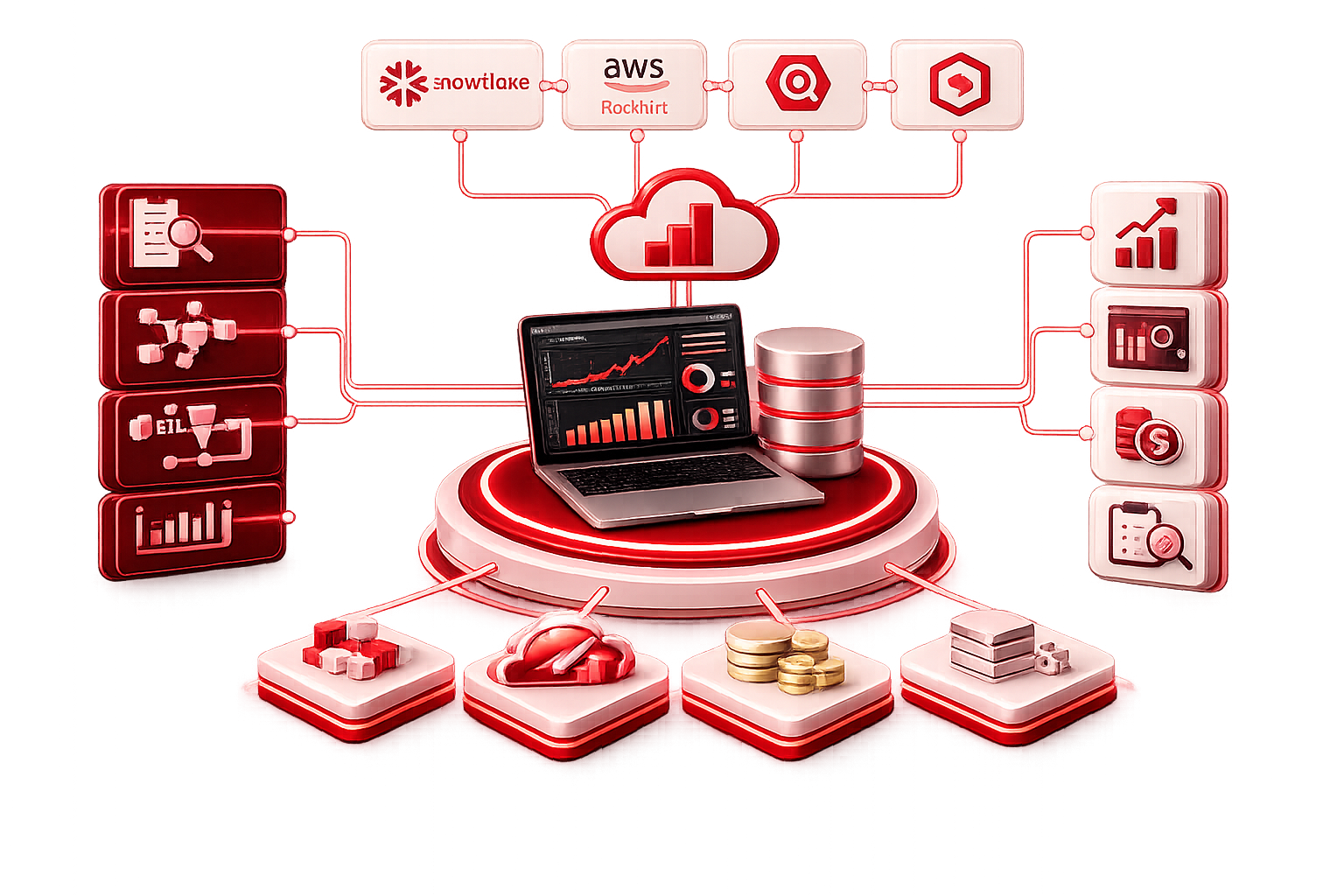
CoreMatrix's Data Warehousing Services cover the complete data warehouse lifecycle: cloud platform selection advisory, dimensional data model design, physical implementation on the target platform, ETL/ELT pipeline integration, query performance optimization, cost governance implementation, BI platform integration, and ongoing data warehouse operations and evolution. Every engagement begins with an analytical requirements assessment that grounds data model design in the specific business questions the warehouse must answer.
Organizations benefit from professionally designed data warehouses most directly through analytical query performance and metric consistency. A well-designed dimensional model with appropriate clustering, partitioning, and materialized view strategies returns complex analytical queries in seconds rather than minutes making interactive dashboards responsive and data exploration practical. Consistent metric definitions in the dimensional model eliminate the version-of-truth debates that derail management reporting and erode stakeholder confidence in analytical outputs.
Strategically, the data warehouse is the most durable component of the enterprise data stack. BI tools come and go; data science platforms evolve; AI frameworks change. The curated, business-aligned analytical data stored in a well-designed warehouse retains its value across tool generations making data warehouse investment one of the highest-ROI positions in the enterprise data infrastructure stack.
Dimensional Data Modeling
Star schema and snowflake schema dimensional model design fact and dimension table architecture, slowly changing dimension handling, conformed dimension design, and the grain decisions that determine analytical flexibility and query performance.
Cloud Platform Optimization
Snowflake virtual warehouse sizing, Redshift distribution key strategy, BigQuery partitioning and clustering, or Synapse dedicated pool configuration platform-specific optimization that delivers query performance without over-provisioning compute resources.
Data Warehouse Cost Governance
Compute credit monitoring, auto-suspend configuration, query cost attribution, resource monitor implementation, and workload management policies keeping data warehouse operating costs proportional to the business value the analytical queries deliver.
Data Warehouse Testing Framework
dbt test implementation for data warehouse quality validation referential integrity tests, uniqueness constraints, accepted value ranges, and custom business rule tests that catch data quality issues before they reach BI consumers.
Our Offerings
Solutions Of This Service
Cloud Data Warehouse Implementation
End-to-end implementation of Snowflake, Amazon Redshift, Google BigQuery, or Azure Synapse Analytics covering account design, network security, user and role management, virtual warehouse or compute pool sizing, and initial data loading from source systems.
Dimensional Data Model Design
Enterprise dimensional model design covering business process fact table design, conformed dimension development, slowly changing dimension handling, date dimension implementation, and analytical layer design that balances query flexibility with performance optimization.
Data Warehouse Migration
Structured migration from on-premises Oracle, SQL Server, Teradata, or legacy cloud data warehouse implementations to modern cloud data warehouse platforms with schema conversion, SQL dialect translation, performance validation, and parallel-run testing before cutover.
Data Warehouse Performance Optimization
Query performance audit and optimization for existing data warehouses execution plan analysis, clustering and partitioning strategy improvement, materialized view implementation, result caching optimization, and workload management configuration that restores analytical query performance.
Data Warehouse Architecture Design
Target state data warehouse architecture design for organizations at the planning stage platform selection advisory, architectural pattern selection (Kimball, Inmon, Data Vault, Lakehouse), data model scope definition, and phased implementation roadmap development.
Data Vault Implementation
Data Vault 2.0 methodology implementation for organizations requiring historized, auditable, and flexible raw data storage hub, link, and satellite modeling, hash key strategy, and automation tooling that delivers the auditability and historical accuracy that regulatory and compliance use cases require.

Use Cases
Solutions Of This Service
Enterprise data warehousing creates the most direct analytical value in industries where large data volumes, complex reporting requirements, and the need for a consistent single source of truth across multiple business units demand purpose-built analytical infrastructure.
Banking & Financial Services
Financial data warehouse implementation consolidating core banking, treasury, risk, and customer data for management reporting, regulatory analytics, and executive intelligence across Saudi banks and financial institutions with complex multi-system data landscapes.
Retail & Consumer Groups
Retail data warehouse consolidating POS, e-commerce, inventory, and CRM data for merchandising analytics, customer intelligence, and supply chain performance reporting across Saudi retail groups with multi-channel and multi-geography operations.
Healthcare Networks
Clinical data warehouse consolidating EMR, lab, pharmacy, and operational data for patient outcome analytics, clinical quality reporting, and operational efficiency intelligence across Saudi healthcare networks with multi-facility data environments.
Government & Public Sector
National data warehouse implementations consolidating cross-agency data for Vision 2030 KPI reporting, public service analytics, and inter-ministerial performance intelligence aligned to SDAIA data governance and NDMO classification requirements.
Telecommunications
Telecom data warehouse consolidating network, billing, customer, and operational data for subscriber analytics, network performance reporting, revenue assurance analytics, and churn prediction feature engineering.
Manufacturing & Industrial
Manufacturing data warehouse consolidating ERP, MES, quality, and maintenance data for production performance analytics, cost variance reporting, quality trend analysis, and supply chain performance intelligence across complex manufacturing operations.
Why Data Warehousing Is Critical
The data warehouse is the analytical backbone of the enterprise every BI report, every management dashboard, and every machine learning feature traces its lineage back to the quality and design of the warehouse that stores the data it consumes.
Primary Value Anchors
Single Source of Analytical Truth
A well-designed enterprise data warehouse establishes one authoritative version of every business metric eliminating the inconsistent numbers from different source systems that create management credibility crises and slow executive decision cycles.
Sub-Second Analytical Query Performance
Purpose-built analytical data models with appropriate clustering, partitioning, and materialization strategies return complex analytical queries in seconds making interactive dashboards responsive and spontaneous data exploration economically viable.
Elastic Analytical Capacity
Cloud data warehouse elastic compute scales query capacity up during peak analytical demand and suspends automatically during quiet periods delivering unlimited analytical capacity at a cost structure proportional to actual usage.
Cross-Functional Data Consolidation
The data warehouse integrates data from every operational system finance, operations, sales, customer service, and supply chain into a unified analytical environment that enables the cross-functional analysis that siloed source systems cannot support.
Historical Data Preservation
The data warehouse preserves the full historical record of business performance enabling trend analysis, year-over-year comparison, cohort analysis, and the long-range pattern recognition that operational systems that overwrite current records cannot provide.
BI & ML Foundation
A well-governed data warehouse is the most efficient data source for both BI consumption and machine learning feature engineering providing clean, curated, and documented data that reduces the data preparation effort for every downstream analytical use case.
Our Advantage
Why Choose CoreMatrix
Innovation-Driven Approach
We implement Snowflake Dynamic Tables, BigQuery Analytics Hub, Redshift Serverless, and Synapse Serverless SQL pools leveraging the latest cloud data warehouse capabilities that reduce operational overhead and improve cost efficiency.
Scalable & Reliable Systems
Our data warehouse architectures are designed for enterprise query concurrency workload management policies, query queuing configuration, and compute tier design that maintains analytical performance as user counts and query complexity grow.
Client-Centric Delivery
We deliver data warehouse implementation in phases prioritizing the analytical use cases that deliver the most immediate business value and validating each phase with business stakeholders before proceeding to the next layer of warehouse complexity.
FAQ
You've Got Questions.
We believe in radical transparency — no jargon, no vague answers.
A database is designed for transactional operations fast reads and writes of individual records for operational applications. A data warehouse is designed for analytical queries fast aggregation and analysis of large historical datasets for business intelligence and reporting. Data warehouses use columnar storage, dimensional data models, and query optimization techniques that make analytical queries orders of magnitude faster than running them against operational databases, without impacting the performance of operational transaction processing.
The right platform depends on your cloud ecosystem, budget, team expertise, and specific workload characteristics. Snowflake is platform-agnostic and excels at multi-cloud deployments and data sharing. Amazon Redshift integrates deeply with the AWS ecosystem and is cost-effective for organizations already on AWS. BigQuery is serverless and excels at large-scale ad hoc analytical workloads in the GCP ecosystem. Azure Synapse integrates deeply with the Microsoft platform. CoreMatrix conducts structured platform selection evaluations for clients at the decision stage, assessing each option against specific technical requirements and organizational context.
Dimensional modeling is the primary analytical data design methodology for data warehouses organizing data into fact tables (recording business events and their quantitative measures) and dimension tables (providing the descriptive context for those events). Good dimensional models answer business questions intuitively queries read naturally as 'show me sales (fact) by product, region, and date (dimensions).' Well-designed dimensional models query efficiently because they are structured for analytical access patterns rather than the operational write patterns that normalize database design optimizes for.
A focused data warehouse implementation covering two to four source systems, a core dimensional model for the primary analytical use case, and initial BI integration typically takes eight to fourteen weeks. A comprehensive enterprise data warehouse covering multiple business domains, six or more source systems, and advanced features like Data Vault historization may take four to eight months. CoreMatrix delivers in phases, making the first analytical domain available to business users as early as week eight while continuing to expand the warehouse's scope.
Yes. CoreMatrix delivers data warehouse migrations from on-premises Teradata, Oracle, SQL Server, and Netezza environments to cloud platforms including Snowflake, Redshift, BigQuery, and Synapse. Migration involves schema conversion using automated tools and manual review, SQL dialect translation for stored procedures and views, ETL pipeline redevelopment on modern tools, performance validation against representative query sets, and parallel-run testing before production cutover. We also use migration as an opportunity to improve the data model and pipeline architecture beyond simple lift-and-shift.
Ready to build a data warehouse that becomes the analytical backbone your entire organization relies on?
Consult with CoreMatrix's data warehouse specialists and receive a platform selection assessment and dimensional modeling proposal covering data model design, source system integration scope, performance optimization strategy, and phased implementation roadmap aligned to your analytical priorities.