
Kubernetes & Containerization Services
Modernize your applications with Kubernetes and containerization. CoreMatrix designs, deploys, and manages scalable, secure, and resilient container platforms that simplify application deployment, improve portability, and enable consistent performance across cloud environments.
Overview
About this Service
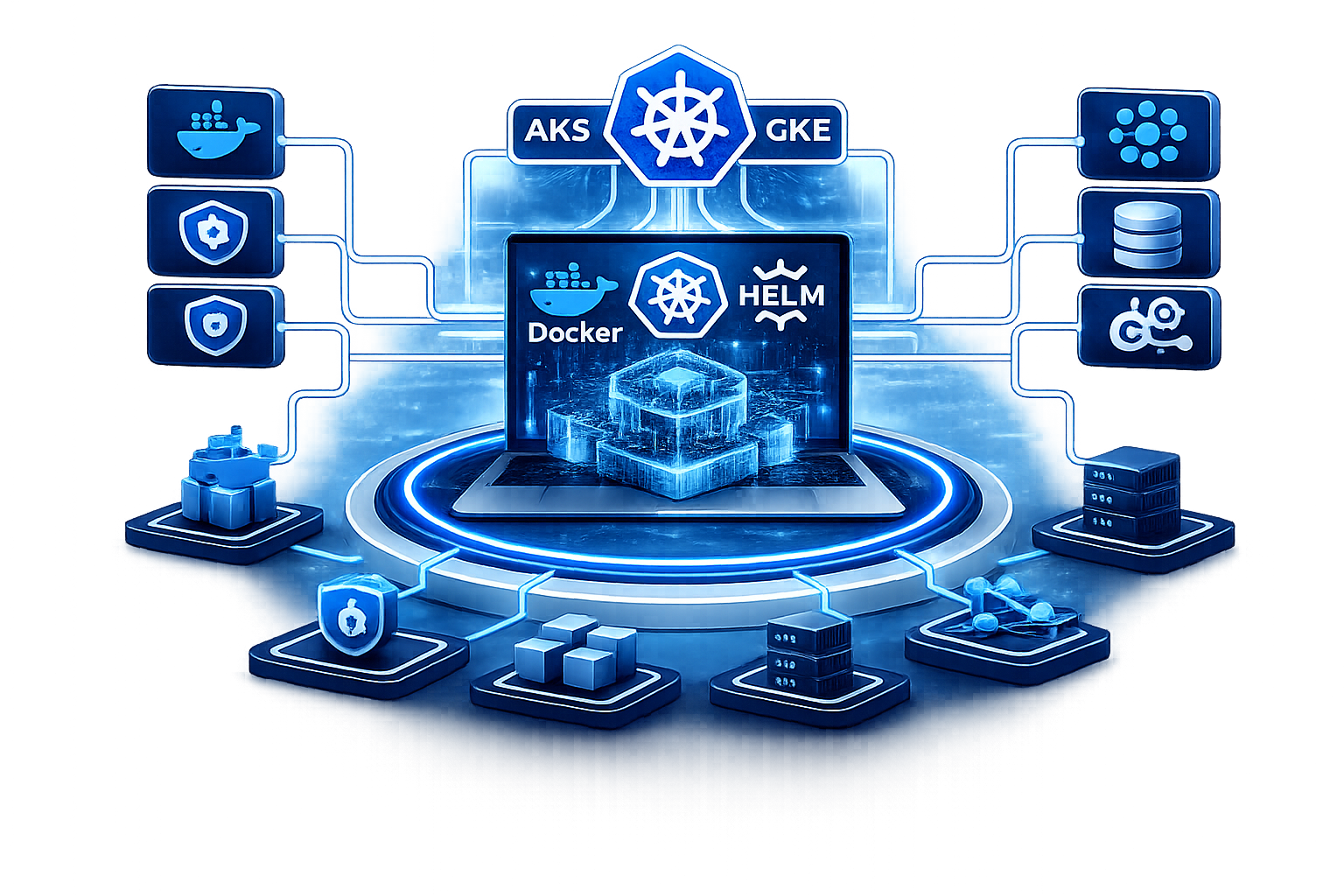
CoreMatrix's Kubernetes & Containerization Services cover the full container platform lifecycle: Docker containerization strategy, Kubernetes cluster design and deployment on managed platforms (AKS, EKS, GKE) or self-managed infrastructure, Helm chart development for application packaging, service mesh implementation, GitOps workflow deployment, platform engineering for internal developer platforms, and ongoing cluster operations and upgrade management. Every engagement is scoped to the client's application architecture and operational maturity.
Organizations benefit from professional Kubernetes implementation most directly through the operational consistency and deployment automation that well-architected container platforms provide. Development teams that previously waited days for environment provisioning get self-service namespaces in minutes. Deployments that previously required manual steps and handoffs between teams become automated Helm releases triggered by Git commits. Incidents that previously required manual intervention to restart failed services become self-healed by Kubernetes's control loop before on-call engineers are even paged.
Strategically, Kubernetes adoption creates an application portability foundation that reduces cloud vendor lock-in and enables workload placement optimization across cloud providers as pricing, compliance requirements, and service availability evolve. Organizations that containerize their application estate on Kubernetes establish the infrastructure abstraction layer that makes future cloud strategy decisions multi-cloud, hybrid, or cloud migration significantly simpler to execute.
Production-Ready Cluster Design
Kubernetes cluster architecture designed for production requirements high-availability control plane, node group strategy, network policy design, RBAC configuration, pod security standards, and resource quota management that keeps clusters stable under real operational load.
Helm Chart Development
Application Helm chart development with environment-specific value overrides, dependency management, upgrade hooks, rollback support, and chart testing standardizing application packaging and deployment across all Kubernetes environments.
GitOps Workflow Implementation
ArgoCD or Flux GitOps implementation that makes the Git repository the source of truth for all cluster state providing declarative configuration management, automated synchronization, drift detection, and complete deployment audit trails.
Service Mesh Integration
Istio or Linkerd service mesh implementation providing mutual TLS between services, fine-grained traffic management, distributed tracing, and circuit breaker patterns delivering the observability and security that microservices architectures require.
Our Offerings
Solutions Of This Service
Docker Containerization Strategy
Container strategy design, Docker image optimization, multi-stage build implementation, base image standardization, container registry setup, image scanning integration, and container build pipeline implementation establishing the containerization foundation that Kubernetes orchestration requires.
Kubernetes Cluster Design & Deployment
Production Kubernetes cluster architecture and deployment on AWS EKS, Azure AKS, GCP GKE, or self-managed infrastructure covering node pool design, networking, storage, RBAC, admission controllers, and cluster autoscaler configuration.
Helm Chart Development & Management
Application Helm chart development, chart testing with helm-unittest, chart museum setup for private chart repositories, and Helmfile management for multi-chart environment definition standardizing application packaging across all development teams and deployment environments.
GitOps Implementation
ArgoCD or Flux CD implementation with ApplicationSet patterns for multi-cluster management, Kustomize overlay structures for environment-specific configuration, Git repository design for cluster state management, and progressive delivery with analysis-driven automatic rollback.
Kubernetes Platform Engineering
Internal developer platform design on Kubernetes self-service namespace provisioning, developer tooling integration, GitOps onboarding workflow automation, and platform operator development using the Kubernetes Operator pattern for custom resource management.
Kubernetes Operations & Cluster Upgrades
Ongoing Kubernetes cluster operations covering upgrade planning and execution, node group rotation, certificate management, etcd backup verification, capacity planning, performance tuning, and incident response for production Kubernetes environments.

Use Cases
Industries We Support
Kubernetes and containerization create the greatest operational value in organizations deploying microservices architectures, managing multiple application environments, or requiring the portability, scalability, and deployment automation that container orchestration enables.
SaaS & Technology Platforms
Kubernetes platforms for multi-tenant SaaS delivery namespace-per-tenant isolation, resource quota enforcement, GitOps deployment pipelines for continuous SaaS releases, and horizontal pod autoscaling that scales tenant workloads without over-provisioning shared infrastructure.
Banking & Financial Technology
Kubernetes for financial application workloads network policy enforcement for PCI DSS microsegmentation, Pod Security Standards for hardened workload isolation, secret management with Vault integration, and controlled upgrade processes that satisfy SAMA change management requirements.
E-Commerce & High-Scale Retail
Kubernetes auto-scaling for e-commerce workloads Horizontal Pod Autoscaler for application tier scaling, KEDA for event-driven scaling, Cluster Autoscaler for node provisioning, and Argo Rollouts for canary deployments that protect conversion rates during releases.
Healthcare Technology
Kubernetes for healthcare software delivery with Pod Security Standards enforcement, network policy isolation between clinical workload namespaces, NDMO-compliant secret management, and GitOps workflows that maintain audit trails for healthcare system change management.
Media & Streaming Platforms
Kubernetes for video processing workloads GPU node pool management for transcoding tasks, KEDA-based scaling from message queue depth, spot and preemptible instance utilization for cost-efficient batch processing, and priority-class resource management for latency-sensitive streaming services.
Manufacturing & Industrial IoT
Kubernetes for industrial data processing workloads edge Kubernetes for on-premises manufacturing data aggregation, K3s for resource-constrained edge nodes, time-series data processing pipeline orchestration, and hybrid connectivity between edge Kubernetes and cloud cluster workloads.
Why Kubernetes & Containerization Is Critical
Kubernetes done poorly is harder to operate than what it replaces. Kubernetes done well is the infrastructure foundation that makes every subsequent application scaling, deployment, and operational challenge significantly simpler to solve.
Primary Value Anchors
Application Portability
Containerized applications run identically across development, staging, and production environments eliminating environment-specific bugs and the 'works on my machine' failures that consume disproportionate debugging effort in non-containerized environments.
Automated Self-Healing
Kubernetes's control loop automatically restarts failed containers, reschedules workloads from unhealthy nodes, and replaces unresponsive pods reducing the manual on-call intervention required for routine infrastructure failures.
Efficient Resource Utilization
Kubernetes bin-packing and auto-scaling eliminate the compute waste of statically allocated application servers running more workloads on less infrastructure and scaling resources precisely with actual demand rather than peak projections.
Zero-Downtime Deployments
Kubernetes rolling updates, canary releases, and blue-green deployment strategies enable production application updates without service interruption protecting user experience during the deployment events that previously required maintenance windows.
Developer Self-Service Speed
Internal developer platforms on Kubernetes provide self-service environment provisioning, standardized application deployment, and namespace isolation reducing the time developers wait for infrastructure from days to minutes.
Multi-Cloud Flexibility
Container workloads on Kubernetes are portable between cloud providers reducing vendor lock-in, enabling workload placement optimization as cloud provider pricing and service availability evolve, and simplifying multi-cloud disaster recovery architecture.
Our Advantage
Why Choose CoreMatrix
Innovation-Driven Approach
We implement Kubernetes Gateway API, eBPF-based networking with Cilium, WebAssembly workloads, and platform engineering practices keeping our clients' container platforms at the current frontier of Kubernetes ecosystem evolution.
Scalable & Reliable Systems
Our Kubernetes architectures are designed for production reliability etcd backup automation, control plane high availability, node group update strategies, resource quota governance, and chaos engineering tests that validate cluster resilience before incidents occur.
Client-Centric Delivery
We provide ongoing Kubernetes operations with monthly cluster health reports, upgrade planning with explicit risk communication, cost optimization recommendations, and clear runbooks that enable your team to operate the cluster independently as their Kubernetes expertise develops.
Building Kubernetes platforms that development teams adopt enthusiastically and operations teams rely on because we design for both audiences from the first architectural decision.
FAQ
You've Got Questions.
We believe in radical transparency — no jargon, no vague answers.
Kubernetes is an open-source container orchestration platform that automates the deployment, scaling, networking, and management of containerized applications. Organizations adopt Kubernetes for automated self-healing (failed containers are restarted automatically), horizontal scaling (workloads scale up and down based on load), declarative configuration management (desired state is defined in Git and enforced continuously), efficient resource utilization (multiple applications share underlying infrastructure), and application portability across cloud environments.
Docker is a containerization technology that packages applications and their dependencies into portable container images that run consistently across environments. Kubernetes is an orchestration platform that manages the deployment, scaling, networking, and operation of multiple containers across a cluster of machines. Docker creates the containers; Kubernetes decides where to run them, how many to run, how to connect them, and what to do when they fail. Both are typically used together Docker for containerization, Kubernetes for orchestration.
Managed Kubernetes services AWS EKS, Azure AKS, GCP GKE offload control plane management to the cloud provider, reducing the operational overhead of running etcd, the API server, and Kubernetes version upgrades. For most enterprise workloads, CoreMatrix recommends managed Kubernetes services the control plane reliability and upgrade management they provide are worth the service cost. Self-managed Kubernetes on bare metal or VMs makes sense for specific edge computing, air-gapped, or sovereign cloud requirements where managed services are not available.
GitOps is a Kubernetes operational practice where the Git repository is the single source of truth for all cluster state application deployments, infrastructure configuration, and Kubernetes resource definitions are all stored in Git and automatically synchronized to the cluster by a GitOps operator (ArgoCD or Flux). This approach provides complete audit trails for all cluster changes, automatic drift detection and correction, easy rollback by reverting Git commits, and a clear operational model that improves both security and change management compliance.
CoreMatrix implements Kubernetes security in layers: Pod Security Standards for workload hardening, RBAC with least-privilege service accounts, Network Policies for microsegmentation between namespaces, secret management using External Secrets Operator with HashiCorp Vault or cloud secret stores, image scanning in the CI pipeline with admission controller enforcement, cluster-level audit logging, and runtime security monitoring with Falco. For regulated industries, we align Kubernetes security configuration to CIS Kubernetes Benchmark recommendations and the specific compliance frameworks applicable to the client's sector.
Ready to build a Kubernetes platform that your engineering teams trust and your operations team can confidently run?
Consult with CoreMatrix's Kubernetes engineers and receive a containerization strategy assessment and cluster design proposal covering platform architecture, GitOps workflow, security framework, and operational runbook structure tailored to your application portfolio and team maturity.