
Predictive Analytics Services
Make smarter decisions with AI-powered predictive analytics. CoreMatrix builds machine learning models that forecast trends, customer behavior, and business risks—helping organizations anticipate change, optimize operations, and stay ahead of the competition.
Overview
About this Service
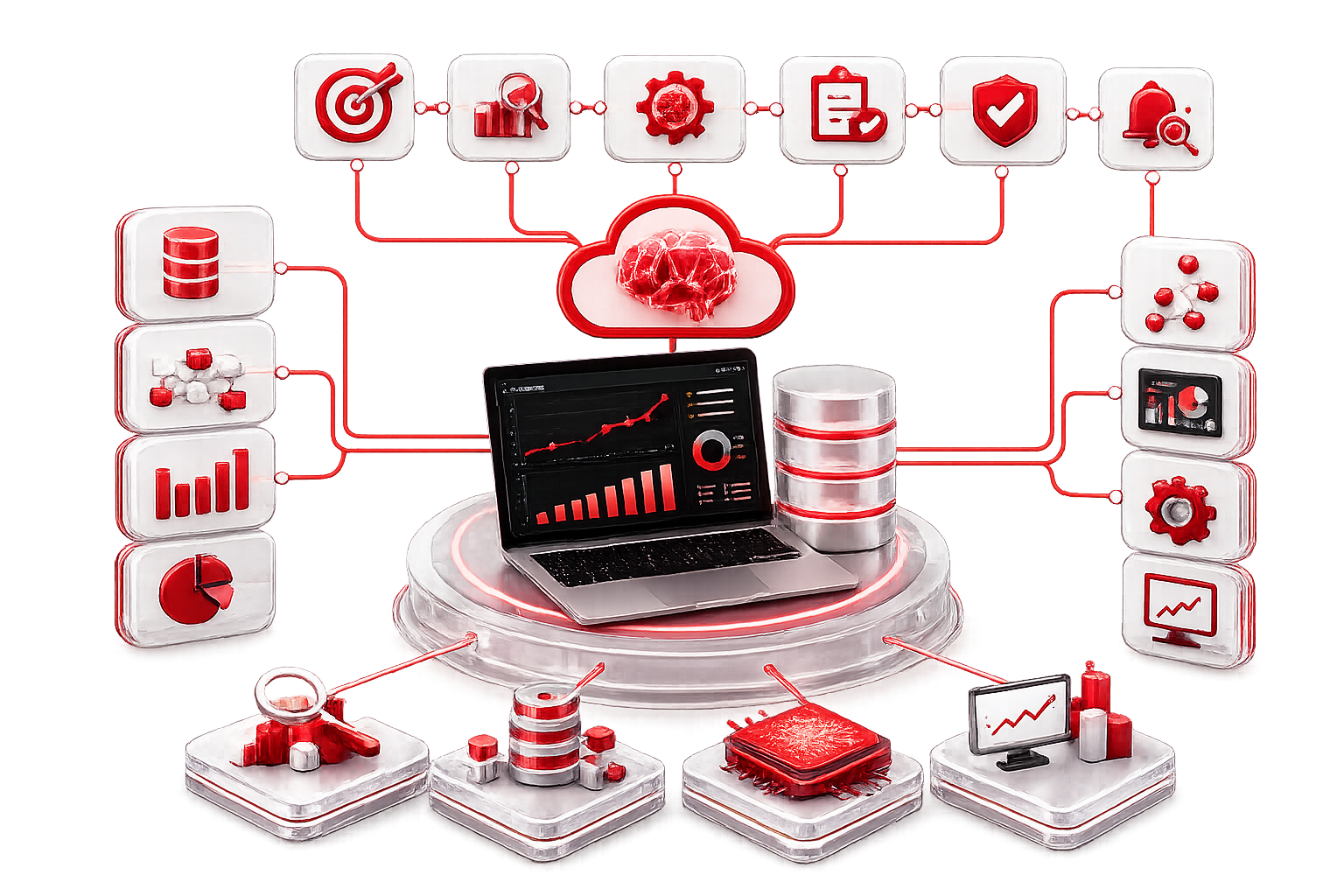
CoreMatrix's Predictive Analytics Services cover the full model development and deployment lifecycle: business problem framing, data exploration and feature engineering, model selection and training, validation and performance benchmarking, production deployment, monitoring, and retraining. Every engagement is grounded in a business outcome objective not model performance metrics ensuring the predictive capability delivers measurable commercial value rather than impressive accuracy statistics that do not translate to operational decisions.
Organizations benefit from predictive analytics most directly through the decisions it improves. Demand forecasting models that reduce inventory holding costs and stockout events deliver ROI in the first inventory cycle after deployment. Customer churn prediction models that identify at-risk customers before they cancel deliver retention intervention value that is easily measurable against a holdout control group. Equipment failure prediction models that enable planned maintenance before unplanned failures deliver cost savings that are directly comparable to historical breakdown costs.
The strategic value of predictive analytics investment compounds with data accumulation. Models retrained on progressively larger historical datasets become more accurate over time providing a data advantage that is genuinely proprietary to the organization that accumulated the data and built the models on it. This compounding proprietary advantage is one of the most durable competitive moats in the data economy.
Business-Grounded Model Design
Predictive model design starting from the business decision being improved framing prediction targets in terms of business outcomes, defining success metrics in business value terms, and validating model outputs against real operational decisions before production deployment.
AutoML & Advanced Model Selection
Systematic model selection using automated machine learning, ensemble methods, and domain-appropriate algorithm evaluation ensuring the production model is the best-performing approach for each specific prediction problem, not the first approach that works.
Production Model Deployment
Model serving infrastructure using REST API endpoints, batch prediction pipelines, or embedded model deployment integrating predictive outputs directly into the operational systems and decision workflows where they influence real business actions.
Model Monitoring & Drift Detection
Production model performance monitoring, data drift detection, concept drift alerting, and automated retraining triggers ensuring predictive accuracy is maintained as the real-world conditions that models were trained on evolve over time.
Our Offerings
Solutions Of This Service
Demand Forecasting Models
Statistical and machine learning demand forecasting models that predict product, service, or resource demand at the right granularity SKU, location, channel, and time horizon enabling inventory optimization, capacity planning, and supply chain efficiency improvements.
Customer Churn Prediction
Machine learning churn propensity models that identify customers at elevated attrition risk before they cancel enabling proactive retention interventions that protect recurring revenue at a fraction of the cost of acquiring equivalent new customers.
Credit Risk & Fraud Detection Models
Statistical credit scoring and machine learning fraud detection models that improve risk assessment accuracy reducing bad debt losses and false positive rates that affect customer experience and operational efficiency simultaneously.
Predictive Maintenance Models
Equipment failure prediction models that forecast component failure probability from sensor, maintenance history, and operational data enabling planned maintenance scheduling that eliminates unplanned downtime and reduces maintenance cost.
Customer Lifetime Value Models
Customer LTV prediction models that quantify the expected future value of each customer enabling acquisition investment prioritization, retention effort allocation, and personalization investment decisions grounded in long-term revenue potential.
Price Optimization Models
Dynamic pricing and price elasticity models that optimize pricing decisions across products, channels, and customer segments improving margin capture while maintaining the competitive positioning and volume targets that revenue strategy requires.

Use Cases
Industries We Support
Predictive analytics creates the most direct business impact in industries where forecasting accuracy, risk assessment quality, and the ability to anticipate customer behavior before competitors do are significant determinants of commercial outcomes.
Banking & Financial Services
Credit risk scoring models, fraud detection systems, customer churn prediction, cross-sell propensity models, and loan default prediction for Saudi banks and financial institutions where model accuracy directly translates to credit loss reduction and revenue growth.
Retail & E-Commerce
Demand forecasting models for inventory optimization, customer purchase propensity scoring, basket analysis and recommendation models, price elasticity analytics, and markdown optimization for Saudi retailers competing on availability and margin efficiency.
Healthcare & Clinical
Patient readmission prediction, disease progression modeling, clinical outcome forecasting, appointment no-show prediction, and health resource demand forecasting for Saudi healthcare networks managing population health at scale.
Logistics & Supply Chain
Delivery time prediction models, carrier performance forecasting, demand signal analytics, route optimization models, and supply chain disruption risk prediction for Saudi logistics operators requiring operational efficiency at scale.
Energy & Industrial
Equipment failure prediction models, energy consumption forecasting, production yield optimization models, and maintenance scheduling analytics for Saudi energy companies and industrial enterprises managing large capital asset bases.
Telecommunications
Customer churn prediction, network congestion forecasting, service upgrade propensity models, fraud detection systems, and customer lifetime value prediction for Saudi telecoms managing large subscriber bases in a competitive digital services market.
Why Predictive Analytics Is Critical
Organizations that predict the future make systematically better decisions than those that only understand the past. In competitive Saudi markets, that decision quality advantage translates directly into revenue, margin, and market share.
Primary Value Anchors
Proactive Decision Making
Predictive models enable action before events unfold preventing churn before customers leave, scheduling maintenance before equipment fails, restocking before stockouts occur shifting from reactive firefighting to proactive business management.
Quantifiable ROI
Predictive model impact is directly measurable churn rate reduction, fraud loss prevented, inventory cost saved, maintenance downtime avoided providing one of the clearest investment return pictures in the analytics capability portfolio.
Competitive Forecasting Advantage
Demand forecasting models calibrated to your specific business patterns consistently outperform industry-average benchmarks and generic tools providing a proprietary forecasting advantage built from your own historical data.
Risk Quantification at Scale
Machine learning risk models evaluate thousands of risk factors simultaneously across millions of customers, transactions, or assets providing risk intelligence at a scale and consistency that human analysis cannot approach.
Resource Allocation Optimization
Predictive models that prioritize interventions by predicted impact directing retention effort to the customers most likely to churn, maintenance resources to the equipment most likely to fail improve the ROI of every operational investment.
Compounding Data Advantage
Predictive models improve with every additional data point meaning the accuracy advantage over competitors without the same data history compounds over time, creating an increasingly durable analytical competitive moat.
Our Advantage
Why Choose CoreMatrix
Innovation-Driven Approach
We integrate large language model-based feature engineering, AutoML for rapid model selection, and real-time streaming feature computation applying the current frontier of ML capability to business prediction problems that deliver measurable commercial ROI.
Scalable & Reliable Systems
Our ML serving infrastructure handles prediction volumes from thousands to millions of requests per day with latency guarantees, fallback logic, A/B testing frameworks, and model versioning that keeps predictive systems reliable in production at scale.
Client-Centric Delivery
We deliver predictive analytics in business-impact increments each model release accompanied by a business validation study that quantifies the decision quality improvement and the commercial value it generates before building the next prediction capability.
Building predictive models that give Saudi organizations the forward-looking intelligence to act before competitors react measured in revenue protected, risk avoided, and opportunities captured.
FAQ
You've Got Questions.
We believe in radical transparency — no jargon, no vague answers.
Predictive analytics uses statistical algorithms and machine learning models trained on historical data to forecast future outcomes. The model learns patterns from past events which customers churned, which transactions were fraudulent, which equipment failed and applies those patterns to current data to predict the probability of similar future outcomes. The output is a probability score or predicted value for each entity being assessed a customer's churn probability, a transaction's fraud probability, an equipment component's failure probability that enables prioritized intervention before the predicted event occurs.
Data requirements depend on the prediction problem, the outcome frequency, and the number of input features. Churn models typically need at least 12–18 months of customer history with sufficient churned customer examples to train on. Demand forecasting benefits from 2–3 years of sales history to capture seasonal patterns. Fraud detection works with millions of transactions where fraud events may represent a small fraction of volume. CoreMatrix conducts a data readiness assessment at the outset of every predictive analytics engagement to evaluate available data and identify augmentation strategies where volumes are limited.
Model integration design is as important as model accuracy. CoreMatrix implements predictive outputs through: API endpoints that serve real-time predictions to operational systems (CRM, credit systems, pricing engines), batch scoring pipelines that populate prediction scores into analytical databases for BI consumption, direct integration with decision workflow tools (marketing automation, credit adjudication, maintenance scheduling), and alert systems that notify the relevant operational team when a prediction score exceeds a defined intervention threshold.
Production model accuracy degrades when the real-world patterns that models were trained on change a phenomenon called concept drift. CoreMatrix addresses this through production monitoring infrastructure that tracks model performance metrics against actuals, data drift detection that identifies when input feature distributions shift from training data, alerting thresholds that trigger review when performance degrades below acceptable levels, and scheduled retraining pipelines that rebuild models on updated historical data on a regular cadence. Every predictive model CoreMatrix deploys includes a defined monitoring and maintenance plan.
Machine learning is the technical discipline of building algorithms that learn patterns from data it is one of the primary methods used to build predictive models. Predictive analytics is the business practice of using those models to forecast future outcomes and improve decisions. Predictive analytics projects use machine learning techniques (regression, classification, time-series forecasting, neural networks) but are evaluated and measured on business outcomes prediction accuracy improvement translated into revenue protected, cost avoided, or decisions improved not just model performance metrics.
Ready to give your organization the predictive intelligence to act before competitors react?
Consult with CoreMatrix's predictive analytics specialists and receive a structured use case assessment and model development proposal covering data requirements, algorithm selection, business validation methodology, and production deployment architecture tailored to your highest-value prediction opportunities.